Pop quiz: When’s the right time to hire more CSMs?
Is it based on ARR? Customer volume? Product complexity? Or some mystical blend of all three?
Linnea Olson (Director of Customer Experience at When I Work) and Nina Wilkinson (Partner at ScaleUp CS) joined us for a webinar on this very topic to share their views on when and how to scale a CS team.
You can watch the webinar or read through this article for a blueprint to follow for when you should hire, the triggers to watch out for, and what to look for in a CSM at every stage of growth.

Meet the Experts: Linnea And Nina
Nina has managed six Customer Success orgs over the years at companies ranging from Series A to D – including standouts like Apollo, Lob, and Canary Technologies.
Nina has built CS teams in-house while helping individuals build their CS careers, and now, through ScaleUp CS, she partners with B2B companies to build and scale their CS orgs.
Linnea has worked in CS since 2014 after beginning her career in sales; it was the relationship-based approach to sales that gave her a taste – and love – for the operational side of Customer Success. Currently, Linnea heads Customer Experience at When I Work.
Together, they have over a decade of CS leadership experience, making them the perfect experts to lead this topic as you think about hiring your founding CSM.
How to Think About CSM Hiring
In the initial stage, the question on many founders’ minds is, what’s the magic number?
Honestly, there isn’t one.
You don’t want to hire based on ARR or customer volume. Instead, you will be best served by thinking about hiring based on the complexity of your needs. Complexity doesn’t just mean that you have a complex product that requires more CSMs to explain it to your customers.
In the early days before product-market fit, the founder is going to do a lot of Customer Success work themself, but as the company grows, it’s not just that there are more customers that need assistance, it’s that the nature and scale of those problems will grow too and quickly become more than the founder can handle.
That’s broad, though, so next we’ll look at specific triggers to watch for that can clue you in to the need for more CSMs.

Hiring Triggers to Watch Out For
To help you think a bit more tactically about complexity, we recommend watching out for the following triggers:
- The founder spends all their time on CS
- Churn is a mystery
- Renewal and upsells are missed
Hire When The founder spends all their time on CS
This is an easy one: how much time does your founder spend on post-sales follow-ups and Customer Success?
If your founder spends over 25% of their time on:
- Onboarding
- Kick-off calls
- Check-ins
Or worse, tag-teaming with other team members like heads of product or even interns, then something needs to change.
This might work for a bit, but you need to bring someone on who can own this fully and build out the processes to scale it.
Hire When Churn is a Mystery
Next up is churn, but it’s not just “high churn.” How tuned in is your team to the reasons for churn?
Nina recalls that it happens far too often that she meets with a CSM and asks them about why a customer churned, and the answer is “I don’t know.”
That's not a good position for you to be in because you can't tell the story behind that to inform product or sales. If you have no process or ability for understanding why customers churn, then you need to hire a CSM to own that process.
By the way, if you need help with diagnosing churn, check out our complete guide to churn analysis.
Hire When Renewals and Upsells are Missed
Similarly, are you missing out on key opportunities for renewals or upsells?
If no one owns the process, then it’s more likely than not that customers will silently fall to the wayside and not get more value from your product. Nina recalls encountering many situations in which a CS team lacks a list of upcoming renewals, increasing the risk of falling behind.
As a result, CSMs are flying blind. They don’t have insights into whose contract is up, or worse, which accounts they have forgotten to speak with.
OK, If You Need a Number, Here it is
We get it, hard numbers are helpful for allocating budget and resourcing from the board.
If you need a number to justify hiring your first CSM, then it’s typically 15-25 high-touch customers or $200,000 to $500,000 in ARR. There’s wiggle room in there because it largely depends on your team size, the product's complexity and price, and the churn rate, but use it as a starting point.
Another helpful number to watch out for is Gross Revenue Churn of over 5%. You will not be able to reach IPO-worthy ARR if your churn exceeds 5%, so keep a close eye on this as your customer base scales.
Are You Actually Ready to Hire?
Let’s say that you’re approaching, or a few steps past, the point where you need to bring in a founding CSM hire.
Are you actually ready for them?
If you can check off three to four of the following, you're in a good spot to hire that founding CSM and help them build out your playbooks and set them up for success:
- Onboarding is documented: This can be rudimentary; it does not have to be soup-to-nuts. A good “version 1” would look like a simple sequence of steps that takes customers from a signed contract to onboarding to your product/service.
- Success is defined: Have you set milestones for your customers that can feed into product and sales? 93% of customers make their renewal decision based on their onboarding experience in those first thirty days.
- Onboarding is stable: Your onboarding flow will change, but if it changes weekly, that’s a problem. You’re ready to hire when you have a stable flow for bringing on new customers and setting them up for success.
- You are tracking renewals: You don’t need anything fancy (though Vitally can help); even a spreadsheet is a good start for getting a read on accounts coming up for renewal.
- Your founder is ready to let go: To effectively onboard a founding CSM, you need your founder to take their hands off the wheel and let someone else drive.
If you can’t say “yes” to three of these, you’ve got some work to do before you look for your first CSM hire.
If you can (and you’re being honest with yourself), continue on with what to look for.
What to Look For in a Founding CSM
Your first CSM should be a Swiss army knife: Someone who lives in ambiguity, who thrives in that experience, and frankly, someone who can build the plane while you're flying it.
Whoever you hire, it’s important that they realize that no processes are permanent and there are few established best practices to follow.
From Nina’s point of view, she’s hired at least 70 CSMs, and for founding CSMs, typically she’s looked for people with:
- 3-6 years of experience in a customer-facing role
- Account management experience
- Solutions consulting experience
In other words, someone who is seasoned enough to juggle multiple priorities and doesn’t need active supervision.
The ideal founding CSM absolutely needs these skills, too:
- Onboarding expertise: While your onboarding process should be stable, it won’t be perfect, so you need someone to take what you’ve built and run with it
- Commercial acumen: You need someone who's comfortable with setting initial revenue targets and driving expansion dollars. While they aren’t your primary sales person, they should be comfortable with driving renewals and expansion.
- The ability to build processes: You need someone who thrives on building and creating processes from nothing. AI tools can help, obviously, but ideally, they have a strategic mindset too, around what needs to get done.
80% of a CSM's job centers on account management and onboarding, so your founding CSM has to have those two skills dialed in.
Evaluating a candidate will require more than a set of criteria to have in the back of your head. Check out our CSM interviewing guide to help you find the right fit for your company.
The Responsibilities of a Founding CSM
Your founding CSM plays a uniquely strategic and pragmatic role.
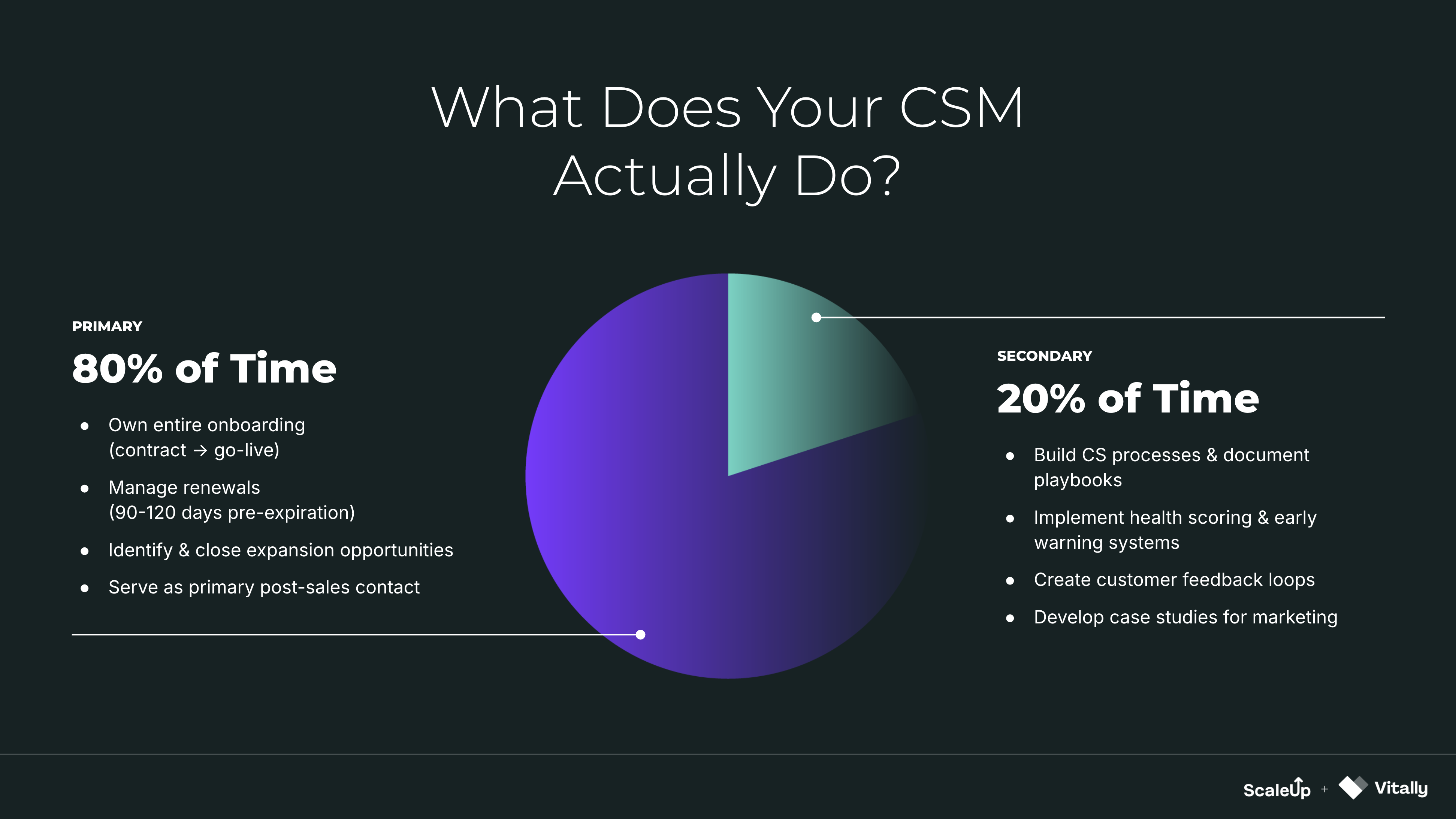
80% of your founding CSM’s time should be spent on the following:
- Onboarding: As we discussed, your founding CSM owns onboarding to ensure the first 30 days of every account are successful. A good founding CSM will also maintain a close relationship with your product team to identify areas for improvement and automation to make onboarding easier.
- Manage renewals: They should work in the 90-120-day period leading up to the renewal date to ensure consistent outreach.
- Expansion: Next, identify and close expansion opportunities. Look for opportunities to add seats, increase adoption, or bump up a tier as accounts use your product.
- Post-sales point of contact: They're the person your customer will go to for help, onboarding new hires, and training. They're going to be your advocate and boots-on-the-ground with your customer base.
And the other 20% should be spent on things like:
- Building initial CS processes and SOPs
- Implementing health scoring and early warning systems
- Creating customer feedback loops with your product team
- Collaborating with marketing to develop case studies
Costly Hiring Mistakes to Avoid For Your First CSM
You’ve learned when to hire a founding CSM, what to look for, and what they should do once they join your company. Before we close, here are a couple of risks to watch out for as you ramp up your hiring efforts:
- Hiring too early
- Hiring too late
When Are You Hiring Too Early?
Hiring too early can be disastrous. If you do not have product-market fit, a repeatable CS process, or any semblance of consistency in your onboarding process, then it’s too early to hire a CSM.
While you may want to offload Customer Success to someone else, you’re not in a place where you have a defined customer makeup, and that is too much ambiguity for a founding CSM to solve for your company.
When Are You Hiring Too Late?
On the flipside, hiring too late is one of the most painful situations to be in.
It feels like getting a budget for a CS team requires jumping through a series of hoops, all the while churn climbs, and leadership is heads-down in the product. If you find yourself in a situation where customers are barely coming through at a pace that can replace the ones leaving, yet there is still no one who owns your CS processes, then you should have hired well before this point.
But you’re not too late. Just follow the guidance above to find the right founding CSM, and you’ll get back on track.
Salaries. Burnout. Secret Job Hunts: Read The Secret Lives of CSMs report
CS plays a pivotal role in your company. The habits and culture you form will shape how churn is managed, how renewals are handled, and how quickly you can scale.
But there’s a lot more to scaling CS than knowing when and how to hire.
Recently, the B2B business world has faced economic turmoil following a brief pandemic-induced boom. Acquiring new customers is now an uphill battle, which makes Customer Success Managers — who are responsible for preventing churn and maximizing the value of existing accounts — even more mission-critical.
In August and September 2023, Vitally surveyed 679 B2B Customer Success Managers in a variety of industries to hear their candid opinions on the topics that all CSMs are thinking about right now, but only discuss behind closed doors:
- Salaries
- Burnout
- The love/hate relationship with their jobs
We wanted to know how CSMs live, how they work, and what keeps them up at night.
“The Secret Lives of CSMs” explores the unvoiced concerns and day-to-day experiences of today’s Customer Success Managers with no sugar-coating whatsoever. Through original research and first-hand quotes, we sought to present an in-depth understanding of the challenges, triumphs, and internal dialogues of B2B CSMs from their perspective.
Click the button below to download the report.
Table of Contents
Request a Demo

Request a Demo
Request a Demo