When CS teams are drowning in customer calls, QBRs, and the threat/promise of AI, does anyone really have time to take a good, hard look at onboarding?
Everyone knows they need to operationalize their onboarding process for scale, but actually doing that is another thing. You need to make the time, though, because onboarding can set customers up for success (or failure) and provide valuable insights for the rest of your teams.
Linnea Olson (Director of Customer Experience at When I Work) and Nina Wilkinson (Partner at ScaleUp CS) joined us for a webinar on this topic to share their framework for developing a scalable onboarding system for new customers that sets them up for success.

Onboarding is a Hidden Revenue Multiplier
Userpilot conducted a study in 2024 that found 74% of customers will churn due to a poor onboarding experience. More often than not, churn doesn’t happen at “month 11,” it happens in the first 45 days. That’s because the first 45-90 days with your product are a critical period where customers will judge how well you can help them achieve their goals.
If integrations stall or APIs fail, your NRR is dead on arrival, and your CSMs have a steep uphill battle ahead. This is where onboarding isn’t just a problem for Customer Success, but becomes a problem for Product and the rest of your company.
Beyond improved retention and revenue metrics, onboarding has another sneaky benefit most chaotic CS teams miss: it gathers intelligence for every other department in your company.
Here are a few examples:
- Executive team: Every milestone you hit is a leading indicator for GRR, and NRR is storytelling ammunition to use at board meetings.
- Marketing: Partner with marketing to identify the best customers, define your ideal buyer personas, and highlight successful customers with case studies.
- Sales: Share customer success stories with sales to narrow down your ideal customer profile and partner with sales on clean handoffs from closed deals to onboarded accounts.
- Product: Share gaps and stumbling blocks with customers in your product and engineering teams. This can help your product team refine the product, improving the customer experience and your onboarding process.
And all of this combined fuels the PLG (Product Led Growth) motions in your company. The faster you learn from your customers, the more those learnings can carry over to the rest of your company.
How to Transform Onboarding From Chaos Into a Growth Driver in 90 Days
Achieving the above is easier than you’d think.
Below, we’ll walk you through three phases you can work through over the next 30, 60, and 90+ days to standardize your onboarding process and turn it into a power-up for your organization.
- Document everything
- Develop handoffs, playbooks, and templates
- Automate and scale
- Assess and adapt
Days 1–30: Documentation and Standardization
The first chunk isn't everybody's favorite, but it's where the real work starts: documenting everything you need to include and working toward standardization.
Start with your handoffs. Note how customers transition between phases of their lifecycle journey and how you can make those transitions as smooth as possible. The goal is to shift away from heroics – where someone jumps in to help a customer haphazardly – and to standardize every customer touchpoint as they onboard to your product. You want people owning specific parts of the process here.
Then, identify your “sticky features.” These are the things that drive the most value for your customer and keep them coming back to your product. We recommend considering the following for customers who recently renewed:
- What are the top 5 features they consistently use?
- What pieces of the software do customers regularly say make a difference in their day?
Then do the reverse. What did churned customers never fully adopt? Compare that against what renewing customers use, and you'll surface the features that matter most. Build those into your health score, and make sure they're part of your onboarding checklist. Without them, customers won't find value, and onboarding is all about quick value.
Days 30–60: Handoffs, Playbooks, and Templates
Take those sticky features and build your template around them to guide new accounts to use them and receive value from your product faster. Then automate the pieces you can.
Think about onboarding in terms of the whole journey. What's the trigger that kicks it off? What happens next? Build the tasks and data sources into the flow so your team can focus on helping the customer and delivering the experience, rather than checking boxes.
Auto-closing tasks are a huge time-saver and keep your team happier and more engaged. Nobody wants to spend Friday afternoon scrolling back through the week, wondering if they actually did the thing. A templated, automated playbook keeps everyone on top of their onboarding phases without that overhead.
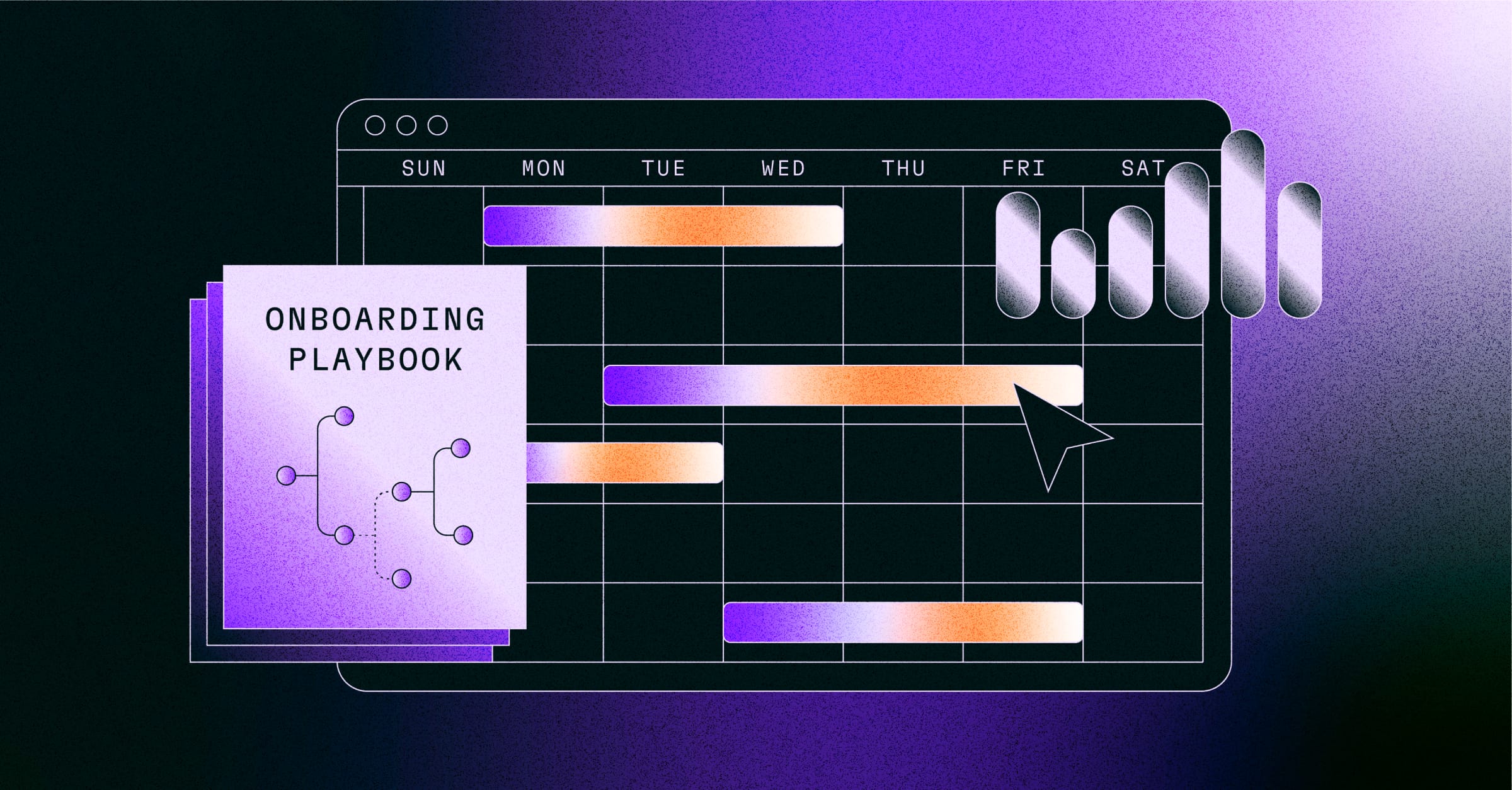
We've seen much better results with onboarding playbooks built in Vitally that trigger when the deal closes. The playbook automates the welcome email, introduces the onboarding manager, sends follow-up emails on a schedule, and uses data triggers to detect whether the customer has booked their kickoff meeting. Don't make your team chase ghosting customers manually – build it into Vitally (or your CSP of choice) so the process is trackable, visible to everyone, and repeatable.
This is what takes you from week-one chaos to a mechanics-driven process where every customer moves through the same milestones for the same sticky features.
Days 60–90: Automating and Scaling
Here’s where we dial in automation to onboard customers at scale.
On the low-touch side, automate as much of that experience as you can. Working through this phase shows you which parts of the customer journey can be activated through self-serve motion, opening the door to more data-driven, product-led growth.
On the high-touch side, capacity planning also comes into play. Team performance dashboards are how you know when to hire your next onboarding manager. As a leader, you're constantly battling finance for budget, especially right now when everyone's being asked to do more with less and to lean on AI to augment teams.
Onboarding milestones and metrics tell you when your team is at capacity. For example, if hiring takes six to eight weeks in a good market and ramping takes another six weeks, you need to know four months in advance that a hire is coming. The metrics give you that lead time so you can start the budget conversation with finance before you're already underwater.
Here’s a red flag to watch out for: your current CSM is handling fifteen onboardings per quarter. That's your signal to hire.
On the flip side, a green flag is when you've hit a repeatable motion of 6-8 customers per quarter per person, which means you've got room for 1-2 more before you need to add headcount. As you build out your systems and use AI for call summaries, project plans, and other repeatable work, you can expand what your current team can handle. The goal is for the system to scale your people, not the other way around.
90 Days and Beyond: Assessing and Adapting
The final phase is cyclical.
Your product will change. Your customer base might change. Being able to evaluate your onboarding program through metrics and adapt it after launch is essential for the 90-day mark and beyond. Sometimes that means going back to the beginning of this journey and reworking pieces from scratch.
The most valuable thing you'll build during this phase is a feedback loop. When your onboarding team notices customers struggling on the same feature in the same session, that's the moment to capture it for your product team. Vitally note templates work well for this—create a "product feedback" template that captures the specifics: what the customer is struggling with, how badly it's impacting them, and how much ARR is tied to the issue. Make sure your product team is reviewing those notes regularly.
Bringing structured customer pain points back to the product doesn't just help the customers you have today. It strengthens your onboarding program for every customer who comes after them.
Final Tips to Unlock Onboarding Success
Let’s wrap up with three things you need in place to unlock everything else and get this moving:
- Write your "done" definition: Define “done” with one sentence, like onboarding is complete when our customer has achieved X outcome. For example, onboarding is done when your customer has successfully synced their Salesforce data and built their first dashboard.
- Define your three milestones: One technical, one behavioral, and one value. On the technical side, Salesforce credentials are configured. For behavioral, the first data sync is completed. Finally, for value, the first dashboard is built and shared with the team.
- Build your sales-to-CS handoff template: Whatever process you already use (Google Docs, Asana, Vitally, Salesforce, or HubSpot), ensure your sales team follows it for every deal. That way, the information pipes cleanly into your CSP, and your CS team isn't starting from scratch on every new account.
Spoiler alert: Onboarding is an ongoing project. You'll always be retooling, finessing, and refining your onboarding process, and that's completely normal. In fact, it's a good thing. As your product evolves and your team grows, you'll need to make adjustments, so be prepared for a long tail of work here.
The good news is that this part is actually really fun to get to do.
Salaries. Burnout. Secret Job Hunts: Read The Secret Lives of CSMs report
Building a scalable onboarding playbook is one of the highest-leverage things you can do for your CS team. But it's also a reminder that CSMs are carrying a lot right now — managing onboarding chaos is just one piece of a job that's getting harder, not easier.
We wanted to know what that actually looks like from the CSM seat. So in 2023, we surveyed 679 B2B Customer Success Managers about the things they only discuss behind closed doors: salaries, burnout, and the love/hate relationship with their jobs.
“The Secret Lives of CSMs” explores the unvoiced concerns and day-to-day experiences of today’s Customer Success Managers with no sugar-coating whatsoever. Through original research and first-hand quotes, we sought to present an in-depth understanding of the challenges, triumphs, and internal dialogues of B2B CSMs from their perspective.
Click below to download the report.
Table of Contents
Request a Demo

Request a Demo
Request a Demo