It’s all CS teams can talk about these days: scale.
How to do more with less, how to serve more customers than ever, and how to automate (almost) everything with AI. Of course, with a poor foundation, even the best attempts at scale can do more harm than good.
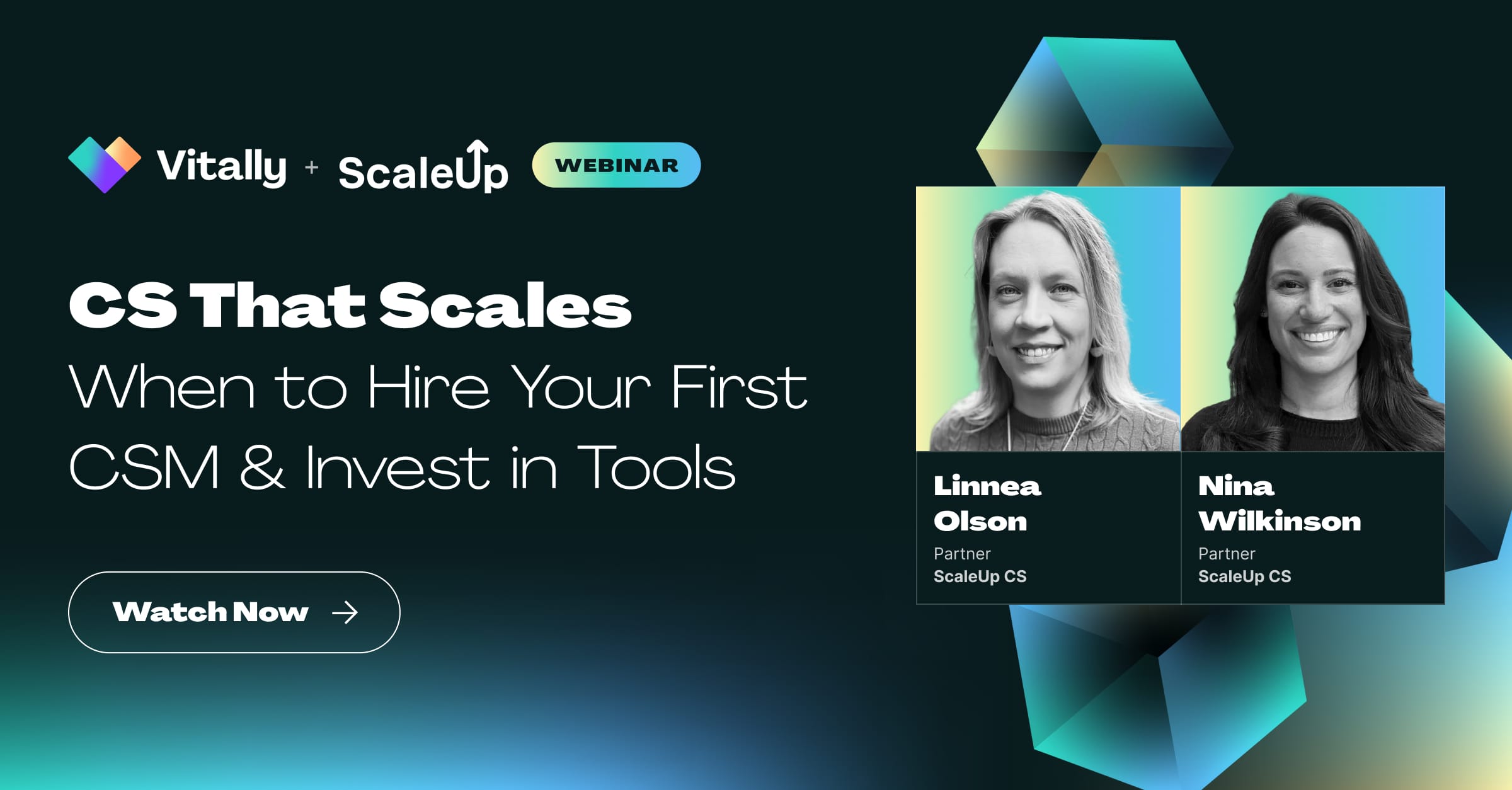
Linnea Olson (Director of Customer Experience at When I Work) and Nina Wilkinson (Partner at ScaleUp CS) joined us for a webinar on this very topic to share their views on when and how to scale a CS team.
You can watch the webinar or read this article for a blueprint to build and scale your CS team.
Meet the Experts: Linnea And Nina
Nina has managed six Customer Success orgs over the years at companies ranging from Series A to D – including standouts like Apollo, Lob, and Canary Technologies.
Nina has built CS teams in-house while helping individuals build their CS careers, and now, through ScaleUp CS, she partners with B2B companies to build and scale their CS orgs.
Linnea has worked in CS since 2014, managing CS operations at Apollo and Jamf after beginning her career in sales; it was the relationship-based approach to sales that gave her a taste – and love – for the operational side of Customer Success. Currently, Linnea heads Customer Experience at When I Work.
Together, they have over a decade of CS leadership experience, making them the ideal experts to guide you on this topic as you consider scaling your CS team.
Before You Scale: Build the Foundation
You can’t scale what isn’t already built and tested.
A solid CS foundation comes down to the three things:
- Documentation: Are your onboarding, renewals, and expansion processes documented and stable?
- Testing: CS processes are not a one-and-done activity; you should regularly test your workflows to identify areas for improvement.
- CRM hygiene: Everyone’s least favorite, but it matters! If your CRM looks like a wasteland of contacts that aren’t active or weird fields that no one can remember setting up and never uses, then some housekeeping is in order.
You don’t need to be perfect, but you do need to be able to nod your head to the above and agree before you can even think about scale. If you’re already getting a bit nervous, let’s quickly run through what having a solid Customer Success foundation looks like and what steps you should take.
Document Everything, Even in Spreadsheets
Start by documenting all of your current CS activities.
Even if you have the founder involved in Customer Success, start by writing everything down, even if it’s basic. Type things out in a shared Drive, record and transcribe voice memos from your phone, or use tools like Granola or even voice-to-text for Google Docs.
Everyone talks to themselves; you're at least being productive. Document all activities for your CSMs to give them a head start on what to build out in programming and repeatable processes.
Avoid Overtooling Too Early
I rattled off a few tools just in the preceding section. We B2B CSMs love our tooling, but don’t over-tool too early.
Both Linnea and Nina have worked with a number of clients over the years who've made the mistake of buying a tool too early and spending $50,000 or more on it, only to have it go unused. No matter how great the software is, if there is no adoption or understanding of how to use it, it’s not useful, and it won’t help you scale.
That’s why I recommend documentation as the first step: build the muscles to figure out your process, then look for software to help you scale.
Involve Your CSMs in Tool Selection
Finally, when you do begin the tool-selection process, involve your CSMs from the start.
Your CSMs are the ones who use the tools every day to support, expand, and retain customers, so give them the authority and autonomy to be part of the product demo and selection process. At the end of the day, you need their adoption in whatever tool you select, or it will join the dozens of others in the tech graveyard of unused software.
Now with that prep work out of the way, let’s discuss optimization techniques you can use in the early stages before automating and scaling your processes.

Optimize Before You Automate
I love the optimization phase, it’s where you get to roll up your sleeves to build fun systems that work.
Your CSMs are the ones working with customers, so trust them and their judgment when working through the following:
- Create your playbooks
- Implement feedback loops
- Shift your thinking on your data
Create Your CS Playbooks
If you’ve already documented your workflows, then this should be a cinch.
Create playbooks for common scenarios your team faces, and source ideas and workflows from across the team because every CSM will have something to contribute. Map out the entire customer journey and think through where those common repeatable scenarios lie, then build playbooks your team can implement.
Implement Feedback Loop
Feedback collection and a way to get it back to other team members, whether it's support or product, will propel your product forward and build trust with your customers in your team. Make sure you're closing that loop by communicating with customers.
And again, a spreadsheet for tracking at this phase is fine. Just make sure it's going somewhere, not into a void where nothing gets done with that valuable information.
Shift Your Thinking on Data
Expansion and renewals aren’t just yearly opportunities; they’re threaded throughout your entire book of business.
The final step in optimization is to shift your thinking about the infrastructure around your data. So when you can see it, and you talk about it, you manage that hygiene. You can't fix what you can't see because it's hidden in spreadsheets, and you can't scale what you can't automate.
Many CS teams that Linnea and Nina work with are using a CRM to manage Sales and Customer Success data, so let’s look deeper into whether a CRM is sufficient for scaling your Success org next.
CRMs vs CSPs: Why Your Customer Success Team Needs Their Own Software
In most cases, CRMs come first.
That makes sense; sales are the lifeblood of any B2B company. The problem is that CRMs are built for transactions, while Success is all about relationships.
Salesforce or HubSpot are great tools, but even the best CRMs stagnate after the sale. You don't see large life cycles and ongoing, like, tracking for the journey. Usually, CSMs don't have the visibility into the product and engagement that they want to understand for their customers. We also see a lack of proactive automation tools in many traditional CRMs for tasks like automatically identifying account risk.
When you're thinking about moving past this phase and getting a specific tool, you'll shift from being very reactive with your CS motion to being proactive and getting ahead of problems.
Software dedicated to Customer Success can scale the impact of even a CS team of one. It does this by:
- Removing the admin slog of data management
- Centralizing customer, product, and relationship data in one place
- Turning data into insights like health scores, engagement data, and sentiment analysis
And some Customer Success software can even automate processes through workflows with custom branching logic, send real-time alerts, and much more.
The last thing you need is complex software that has your CSMs sifting through four different screens just to understand how to prep for their next call.
When you're looking at these for your team, think about tools with four main pillars:
- Customer hubs to centralize data and focus your team.
- Automation to remove as much admin slog as possible.
- AI-powered features to cut down on admin work and answer questions about your data.
- Analytics and reporting tools that reveal key insights.
It’s also helpful to consider your “must-haves.” These will depend on your team size and needs, but we recommend prioritizing:
- A platform that centralizes all of your data – CRM, product, customer, and support – in one place.
- Startup-friendly pricing to help you ease into it and scale as needed.
- A fast implementation timeline. The last thing you want is to wait 90 days (or more) to be onboarded and ready to go.
How to Leverage AI and Automation When Scaling Your CS Org
By now, your CS processes are documented and optimized, so let’s get to automation and scale.
First off, don’t be shy about automation. Customers these days expect automated emails. Personalize what matters and use automation to support the rest.
We’d break automation into the following steps:
- Explore how AI can support you
- Look for gaps and low-hanging fruit
- Prioritize time savings over complexity
Explore How AI Can Support You
There are so many options to make your small team seem and act like a bigger team these days, using simple tools that might sound hard to implement, but they're faster than you think.
It’s 2026, AI isn’t just some far-off future trend. Most teams Nina and Linnea work with use it every day, and noted that it’s been predicted that by the end of 2026, a CSM will have 25-50% more bandwidth because of the integration with AI tools.
Start small and build your AI adoption gradually.
Look For Gaps
To be clear, AI won’t replace CSMs.
Many in Customer Success are getting a bit nervous, but the true value of CS lies in the relationship-building CSMs do, not in the grind of manual busywork.
The key is to look for gaps in your team’s workflow where AI can assist. Things like:
- Gathering insights
- Recording calls, generating notes, and next steps
- Identifying risks
- Spotting expansion opportunities
And much more.
This isn’t a recommendation to replace all your CSMs with bots. But with AI, you can augment your workforce and prime your team for scale.
Focus on Time-Savings Over Complexity
It’s tempting to sign up for complex enterprise software that makes bold claims about AI and automation.
You don’t have to jump there, at least not right away. In the early going, focus on areas where you can save your team time. If something takes your CSMs six clicks to do, then find a way to automate it. Or at least cut down the time invested in each task. Thinking about automation this way puts more time back in your team’s calendar and frees them up for higher-value customer-facing work.
Don't be afraid to start small. Automate one thing. Next month, automate one more thing. After a while, you'll see it's an engine that keeps running for you and will really support your post-sale functions.
Scale Your CS Team With Segmentation and Specialization
As you scale, you can’t have everyone on the team doing everything. Your two best friends in scaling sanely are segmentation and specialization. Let’s review when and how to implement each.
When and How to Segment
While the answer to this question is highly dependent on your team size and structure, a good rule of thumb is:
- You’ve hit your Series C
- You have 10+ CSMs on the team
- You are closing in on $25M ARR
In Linnea’s and Nina’s experience, this is often the right time to think about segmentation to enable scale. To get to this point, you often intentionally do the things that don’t scale because you’ll learn by doing that way (and if we’re honest, that’s what happens at startups anyway).
Once you hit the stage where you have enough ARR coming through and you have a larger team, you need to break that out into segmentation.
There are a bunch of ways to think about segmentation, like:
- Enterprise vs Mid-Market vs SMB
- Tech touch
- Pooled model
However you choose, it’s important to select the right success metric for your model.
For example, on an enterprise or mid-market team, you're looking at things like NRR, GRR, logo retention, expansion opportunities driven in, and expansion dollars closed, if you're targeting them. That's what those teams look like. On the pooled model side, you're looking at first response time. It's a little more support in that sense, but you're looking at things like CSAT scores, the volume of renewals coming through, or expansion opportunities driven in.
When and How to Specialize
Beyond segmentation, specialization is a great way to scale your CS org.
This often starts by splitting out your onboarding function into a specialized team. CSMs do a lot of context switching every single day. They hop from one priority, one type of client, and one fire we're constantly putting out. One of the key things you can do to really maximize your CS team is to split out the onboarding function, and potentially split out renewals on the growth side.
Nina recommends that teams start with onboarding because that way, you have a team dedicated to just making that onboarding rhythm work, which is especially important if you have a more technical product that requires complex integrations or setup.
This can be helpful for your CSMs, who may struggle with the technical aspects of onboarding, by putting individuals on your team in situations where they can succeed. This is obviously a win for your customers, but it can also help with employee retention and team morale.
See it in Action: How Apollo Scaled Customer Success
On the webinar, Linnea and Nina shared their firsthand experience leading CS at Apollo.
Apollo is a sales data platform with four primary product lines and additional add-ons and upsells. While at Apollo, they focused the onboarding team on getting customers to try at least two base products and one add-on. Then, the CSM team (measured against product adoption) focused on getting accounts to engage with the product, providing the team with a leading indicator for upcoming renewals.
The CS team also collaborated with Apollo’s BI team to run an analysis of their customers to predict renewals and churn based on product adoption and answer questions like:
- If a customer used three products, what was their likelihood of renewing?
- How many of those customers actually got to renew or potentially expand on the platform?
- If they used all four products, what did that number jump up to? What did our retention metrics look like?
- What could they predict in terms of that renewed health?
This information was critical and enabled the CS team to have strategic conversations about increasing adoption to drive renewals, rather than looking back and wondering why customers churned.
Segments and specializations will change as your team grows and the product evolves. So bear in mind that what works this year may not work next year, and be prepared to refine and adjust.
The Best Tools to Help Your Customer Success Team Scale
From analytics to productivity, there are a number of tools your Customer Success team can leverage as you scale.
To make things simple, refine your search by the following product categories:
- Customer Success Platforms (CSPs): The backbone of a scaled CS org. Unlike a CRM, a CSP is built around relationships rather than transactions, giving your team visibility into the full customer lifecycle — from onboarding progress to health scores, renewal timelines, and expansion signals — all in one place.
- Analytics tools: Give your team a shared view of what's actually happening across your book of business. Look for tools that surface account health trends, cohort-level retention data, and leading indicators for churn.
- Productivity tools: You need to protect your CSMs' time. Whether it's call recording, AI-generated meeting notes, or inbox management, the goal is to reduce administrative overhead so your team can spend more time with customers.
- In-app tracking: This is non-negotiable for a B2B SaaS company. Understanding how customers engage with your product, including which features they use, where they drop off, and what they haven't touched, is the data that separates proactive CS from firefighting.
- AI-powered tools: The best AI tools don't replace CSMs; they just handle the grunt work. Look for tools that can summarize accounts, flag risks, and draft follow-ups so your team can focus on the judgment calls that actually require a human.
There are point solutions for each of the above, but if you're looking for a single platform that covers all five without the implementation headache of enterprise software, Vitally is worth a close look.
Vitally brings your product, customer, and support data under one roof, with built-in health scoring, workflow automation, and AI that can answer questions about your accounts on demand. You can see Vitally for yourself with a product tour here.
Salaries. Burnout. Secret Job Hunts: Read The Secret Lives of CSMs report
CS plays a pivotal role in your company. The habits and culture you form will shape how churn is managed, how renewals are handled, and how quickly you can scale.
But there’s a lot more to scaling CS than knowing when and how to hire.
Recently, the B2B business world has faced economic turmoil following a brief pandemic-induced boom. Acquiring new customers is now an uphill battle, which makes Customer Success Managers — who are responsible for preventing churn and maximizing the value of existing accounts — even more mission-critical.
In August and September 2023, Vitally surveyed 679 B2B Customer Success Managers in a variety of industries to hear their candid opinions on the topics that all CSMs are thinking about right now, but only discuss behind closed doors:
- Salaries
- Burnout
- The love/hate relationship with their jobs
We wanted to know how CSMs live, how they work, and what keeps them up at night.
“The Secret Lives of CSMs” explores the unvoiced concerns and day-to-day experiences of today’s Customer Success Managers with no sugar-coating whatsoever. Through original research and first-hand quotes, we sought to present an in-depth understanding of the challenges, triumphs, and internal dialogues of B2B CSMs from their perspective.
Click the button below to download the report.
Table of Contents
Request a Demo

Request a Demo
Request a Demo