Most CSMs can quickly rattle off which of their accounts are happy and which aren’t. Fewer can pinpoint which of those happy accounts are ready to buy more and when.
At the same time, today’s CSMs are expected to wear their sales hats and expand their accounts to drive more revenue for the business, not just retain clients and stand pat.
AI can close the gap between customer health and expansion by turning usage patterns, sentiment data, and engagement signals into a prioritized list of accounts primed for upsell conversations. This guide breaks down the specific AI-powered tactics CSMs are using right now to surface expansion opportunities earlier, craft more relevant outreach, and consistently grow accounts without the guesswork.
Why Traditional Expansion Playbooks Fall Short at Scale Without AI
Imagine it: You’re scrolling through a spreadsheet of 50+ accounts trying to figure out who might be ready for an upgrade between customer calls and team meetings. All while squeezing in lunch at your desk.
Experienced CSMs may have found a way to strike a balance between cross-referencing health scores, pulling conversations from several weeks prior, and flagging accounts that haven’t complained recently, but what if you don’t have years to learn how to do that?
Modern B2B customers generate more behavioral data than any CSM can meaningfully process in a QBR cycle. From usage spikes, customer size changes, and shifts in support sentiment, there are several data points you need to monitor to drive expansion.
The problem is that, under manual review, most of these signals get missed. And that's the problem AI solves. Not replacing your judgment or the relationship you’ve built, but feeding them the right signal, at the right time, about the right account.
How AI Identifies Hidden Upsell Signals in Your Account Data
The signals that indicate an account is ready for an expansion conversation are almost always already in your data; you just can’t see them all at once.
AI (and the right Customer Success Platform) changes that. By unifying product usage, support history, and revenue data in a single platform, AI can surface patterns that no human could reliably track across an entire book of business.
Here are the specific signals that matter:
- Seat count approaching license limits: When an account’s active user count is trending toward their contracted cap, it’s a clear upsell opportunity. The right AI tool can flag these accounts automatically, well before they hit the ceiling.
- Feature adoption velocity toward higher tiers: Customers who are rapidly adopting features associated with your premium or enterprise tiers are prime candidates for timely outreach to upgrade to the next tier.
- Positive sentiment trends in support interactions: When support ticket sentiment improves over time (shorter resolution times, higher satisfaction scores, fewer escalations), this may signal a more opportune time to approach an expansion conversation.
- Usage spikes tied to business milestones: Sudden increases in product activity often correspond to internal growth events, like new team hires, product launches, or new market pushes. AI detects these spikes and connects them to expansion timing, so you’re reaching out when customers are actively investing in growth.
- Cross-product usage gaps: When an account is heavily using one part of your platform but hasn’t adopted adjacent features or products they’d clearly benefit from, AI can flag the gap and recommend a targeted cross-sell.
The real power comes from connecting these signals across systems. Rather than wait for that lucky moment when the stars align, you can proactively identify expansion opportunities and act when the time is right. Next, we’ll share actionable ways to incorporate AI into your CS processes.
5 Practical Ways CSMs Can Use AI to Drive Expansion Revenue
Enough with the theoretical! Let’s get practical.
Each of the following AI applications is something you can implement today to drive expansion conversations:
- Predictive scoring
- Automated account health tracking
- AI-drafted messaging
- Intelligent timing for outreach
- AI-powered QBR prep
Predictive Expansion Scoring
By using smart features such as health scores and AI analysis, you can generate a dynamic likelihood score for each account based on a combination of health indicators, usage patterns, and historical data.
Think of it as a churn score in reverse: instead of flagging risk, you’re surfacing readiness.
In practice, rather than reviewing each account equally, you can prioritize accounts flagged as good candidates for expansion. You can even set up alerts to flag these opportunities as they arise. That means more of your conversations are happening with accounts that are actually ready to buy, and fewer are dead-end calls where timing is wrong.
Automated Account Health-to-Expansion Correlation
Expansion conversations don’t just depend on a customer being happy; they depend on a customer being happy at the right moment.
By using AI to track product usage and customer sentiment, you can analyze an account and spot windows where expansion conversations are most likely to land. For example, an account that just resolved a series of support issues and has seen a health score jump from 62 to 81 over 45 days is probably in a different headspace than one that’s been flat at 85 for a year.
The right AI tool can distinguish between these scenarios and recommend the appropriate outreach timing for each.
AI-Drafted Personalized Upsell Messaging
We haven’t even mentioned everyone’s favorite use case for AI: generating content like emails and tasks.
No, you shouldn’t let ChatGPT write everything for you. But you can use an AI tool to tap into your data and surface relevant talking points or milestones to include in your customer outreach.
For example, you can easily generate a message like the following if your AI tool has access to relevant account data:
“Hi [Name], I noticed your team’s product usage has increased 40% over the last month, with several new users joining your workspace. I’d love to connect to make sure you’re getting the most out of [product] as you scale.”
That’s far more effective than a generic check-in, and it takes seconds to review and send.
Intelligent Timing Recommendations for Outreach
Timing is everything in expansion.
Reach out too early, and you’re just a point of friction. Reach out too late, and you miss your chance. AI analyzes patterns across your customer base to recommend the optimal window for each account based on their specific journey.
When AI flags that a customer’s active users jumped 25% in 30 days, that’s your cue to start a seat expansion conversation. When it detects that an account has just hit its 90-day mark with consistently high engagement, that’s a prime window for discussing a product tier upgrade.
You can’t possibly stay on top of all this yourself, but an AI Co-pilot like Vitally’s can help.
AI-Powered QBR Prep with Expansion Insights
Quarterly business reviews are one of the highest-leverage touchpoints in a CSM’s calendar, and they’re also notoriously time-consuming to prepare.
AI can dramatically accelerate QBR prep by auto-generating account summaries, surfacing key usage trends, and identifying specific expansion opportunities to bring into the conversation.
Instead of spending hours pulling data before a QBR, you can review an AI-generated brief covering the account’s health trajectory, key milestones, risks to address, and expansion recommendations, along with supporting data. That way, the meeting becomes more strategic, personalized, and likely to move the expansion needle.
Check out our guide to using AI for QBR prep, including sample prompts.
Cross-Sell Recommendation Engines Based on Usage Patterns
You don’t need to just upsell to expand an account; cross-selling can be useful too. Cross-selling is hard to run manually, though, because it requires understanding both what a customer uses and what they’re missing.
AI-powered recommendations solve this by analyzing usage patterns across your customer base and identifying high-probability cross-sell opportunities based on what similar customers adopted next. For example, in a recent webinar, Nina Wilkinson and Linnea Olson shared their experience scaling CS at Apollo. While at Apollo, they focused the onboarding team on getting customers to try at least two base products and one add-on. The CS team collaborated with Apollo’s BI team to analyze customer data to predict renewals and churn based on product adoption and to determine which usage patterns most likely led to renewals and expansions.
While this took considerable effort at the time, an AI tool with access to your data can run this analysis for you in minutes.
How to Use AI For Upsell Outreach Without Sounding Like a Robot
We covered it above, but it’s worth repeating: Yes, AI can be used to either write or edit your messages. But customers are savvy, and some can tell when they’re hearing from their CSM they know and love versus a robot.
And there’s nothing that kills an upsell faster than getting caught letting AI write all of your emails.
The key is to automate the right things. Not by automating personalization away from the CSM, but by doing the legwork of digging up data that makes real personalization possible.
Here's what a practical AI-assisted workflow looks like.
Feed in the account context. A prompt that actually works:
You are a customer success manager writing to a key account. Here's their context: [Account Name] has 18 of 20 seats actively used, adopted Feature X at 95% over the last quarter, and their CS health score has moved from 72 to 88 over six months. They're in the [Industry] space, and their primary business goal from onboarding was [Goal]. Draft a short, consultative email that opens with a specific milestone they've hit, ties it to their stated goal, and makes a natural case for how [Feature Y / Upgrade Tier] builds on that progress. Tone: warm, direct, peer-to-peer. No corporate filler. Under 150 words.
That prompt produces something like this:
Hi [NAME],
Your team just crossed 95% adoption of the reporting suite, which is great for a team that's been in for six months. Given that your original goal was to reduce time-to-insight for your ops reviews, I wanted to flag that our advanced analytics tier offers a few capabilities that directly extend what you've built, particularly in custom dashboards and automated digest reports. Worth a 20-minute call to walk through it? I can pull up your current usage data and show you exactly where the gaps are.
Is this email perfect? Not exactly – but it is much better than the generic copy ChatGPT would spit out with zero context.
A few prompt frameworks worth having in your toolkit:
- Milestone-to-upgrade: Lead with a specific usage milestone, connect it to the customer's stated business outcome, and bridge to a feature or tier that extends that outcome.
- Expansion timing: Reference a capacity signal (seats at 90%+, storage near limit, etc.), frame it as a planning conversation rather than a sales push, and offer to walk through projections.
- Stakeholder-centric: Acknowledge a new stakeholder's engagement, offer a personalized onboarding or context-setting call as the in, and use the conversation to surface broader expansion needs.
AI can pull data and draft, while you can edit and perfect to match your voice. The goal isn't to automate the relationship as much as it's to give you better raw material than a blank email window.
The Best Customer Success Software for AI-Powered Upsells and Expansion
If one thing is clear from this article, we hope it’s the fact that the quality of your AI outputs will hinge on the quality and amount of your data.
No matter how sophisticated your AI model is, without valuable context from your product, customers, and communication history, the insights it provides will be no more useful than those from a Magic 8-Ball.
That’s why we recommend prioritizing a platform with the following characteristics:
- Ease of integration with your tools – especially your CRM, support tickets, and product usage data.
- A flexible API for custom integrations so you can connect all of your tools and not just the few that your platform natively supports.
- Purpose-built AI for Customer Success. While LLMs may be a major help, they have their limits and can only get you so far.
Of all the tools available for CSMs today, our favorites are:
- Vitally: Vitally's AI Copilot captures insights at scale, automates repetitive tasks, and turns knowledge into shared team intelligence. Vitally is flexible, easy to use, and quick to implement. Vitally’s strength lies in its ability to collect usage data, notes, transcripts, tickets, and NPS data and turn them into structured insights.
- ChurnZero: ChurnZero offers AI-powered "always-on digital teammates" that summarize customer information, suggest tasks, and draft content. AI agents require additional credits from their "AI Marketplace."
- Planhat: Planhat excels in flexibility and data-warehouse integration, with AI features that integrate with Gemini, OpenAI, and Anthropic. Unlike Vitally and ChurnZero, Planhat mainly leans on external AI functionality rather than native features.
- Gainsight: The most enterprise-centric option. Gainsight acquired Staircase in 2024 to add AI capabilities for sentiment analysis, risk identification, renewal forecasting, and task automation.
Each of them packs in a ton of useful features that can assist and automate your expansion and cross-selling process, so choosing one comes down to:
- Budget
- Implementation timeline
- How well their features suit your needs
While all four platforms offer strong AI capabilities, Vitally stands out for CS teams that want to move quickly and build their expansion process around native AI rather than stitched-together integrations. You get the flexibility to design your own workflows, with an AI Copilot purpose-built for the job, not retrofitted from a general-purpose model.
Here’s what one customer has to say about Vitally’s AI capabilities on G2:
“In just one year, Vitally has fundamentally transformed our Partner Success organization… it has truly become the central nervous system for all our customer-facing activities. The new AI-powered features are phenomenal. The Meeting Recorder automatically joins, transcribes, and summarizes our Zoom calls, and the AI Copilot helps us instantly uncover risks and key insights from across the entire customer account. The AI meeting summaries alone have been a massive time-saver and have significantly improved our post-meeting follow-up.”
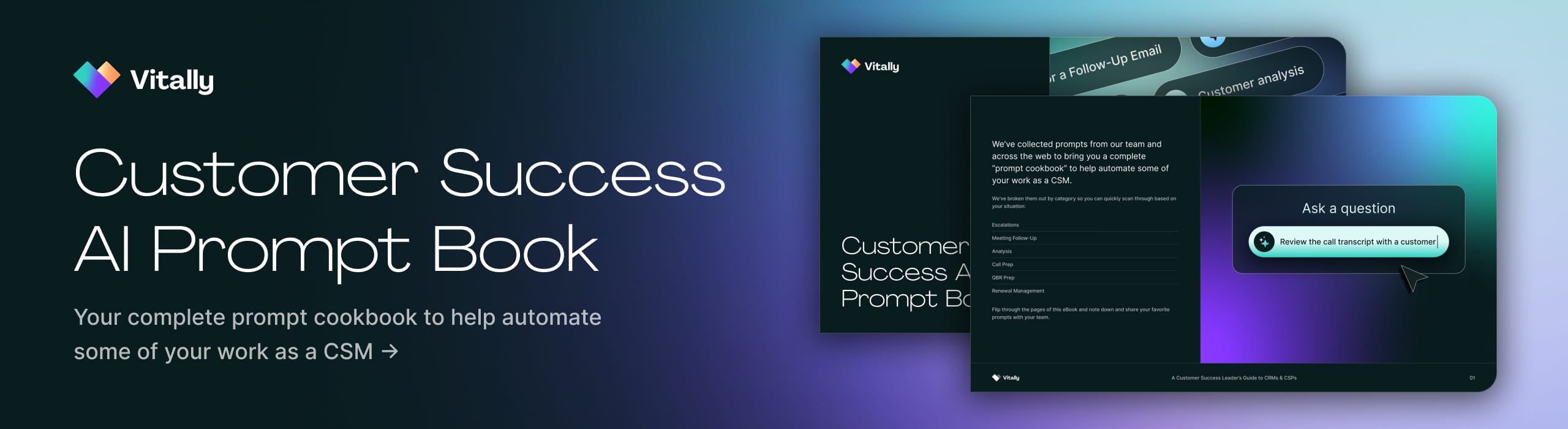
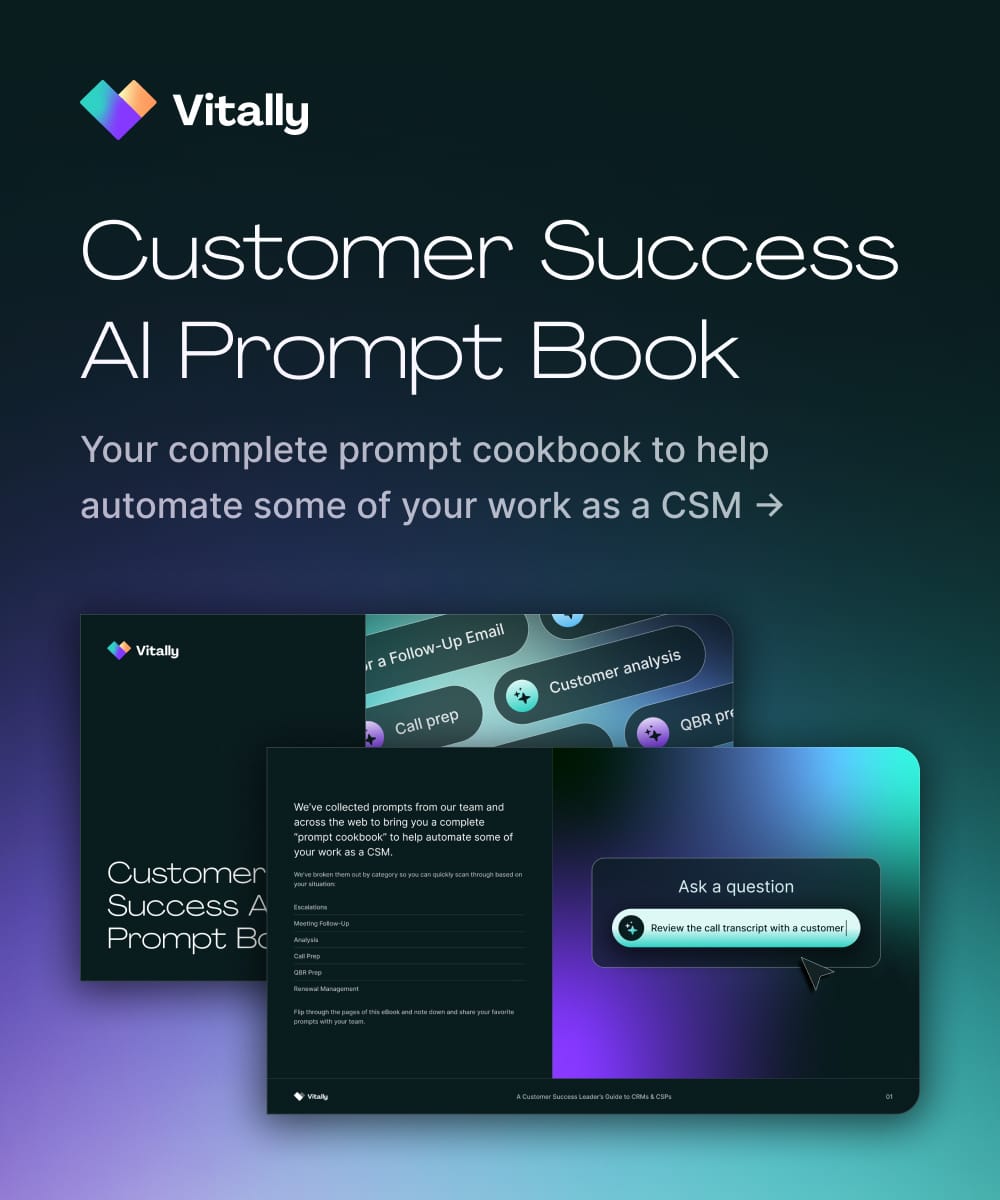
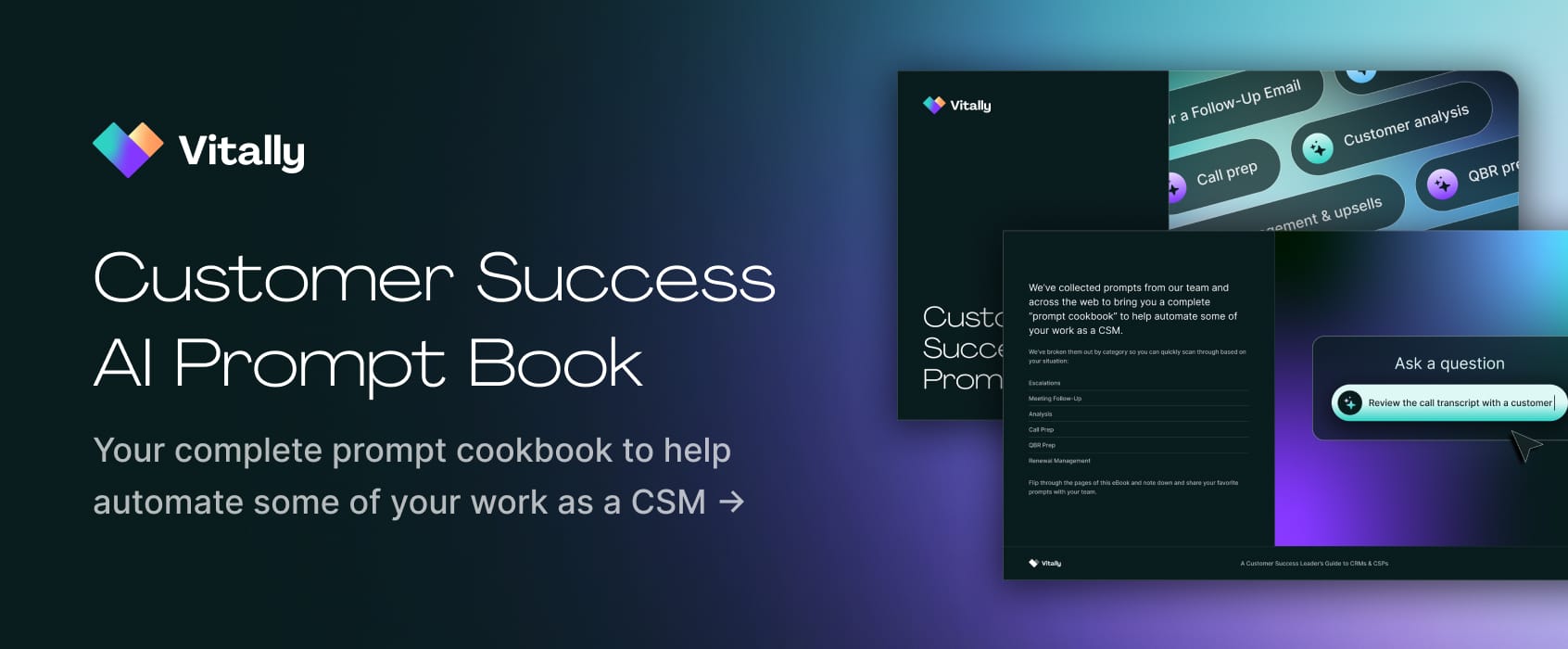
Power Your CS Workflows With the Customer Success AI Prompt Book
With the right blend of AI in human-driven workflows, you can spot and react to expansion opportunities as they come up rather than find out they passed you by months ago.
But AI can be used for so much more than steering accounts to renewals and upsells. You can use AI to assist with QBR prep, handle escalations, and even summarize meetings and generate to-dos and next steps.
We compiled a list of our favorite prompts to automate your CS workflows, from spotting churn risks to meeting follow-up. Save your favorite prompts, create a custom GPT, and see how much time you can save across all of your accounts.
Click the button below to get your free copy.
Table of Contents
Request a Demo

Request a Demo
Request a Demo