It’s all we hear these days: move faster and adopt AI into your workflows.
This sounds great in theory, but what does it really mean? Should CSMs hand the keys over to ChatGPT and let it talk to customers instead? Should CS orgs hire fewer CSMs and let AI automate more processes? Or could CSMs use AI to deliver a better customer experience while carving more time out of their week?
We’d like to think it’s the latter. AI isn’t a complete substitute for the face-to-face value a CSM provides, but it can be a great way to offload the repetitive tasks involved in analyzing and mitigating churn, freeing your team up for higher-value work.
In this guide, we'll share how AI is shaping CS and how to leverage AI in your churn management process.
How AI is Transforming Customer Success
AI can be used for so much more than generating emails or automating support.
To be clear, there are companies using AI for those tasks, but they’re limiting themselves. We find that Customer Success teams thrive best when AI is used to augment their processes rather than replace them. That means doing things like:
- Automating key tasks: AI tools can turn call recordings into actionable next steps, update customer health scores, and much more. Think of all the repetitive tasks that suck up your time and don’t move the needle; chances are, AI can handle them.
- Speeding up the time to insights: AI can ingest large amounts of data from customer interactions and customer data, allowing you to spot trends faster or even ask AI about your own data.
- Empowering teams to do more at scale: This means you can support more customers faster. CSMs provide tremendous value through the relationship-building work they do with customers. With AI, you can free up more hours for that higher-value work and support more customers without tearing your hair out.
We’ve all heard the audacious claims made about AI tools and how they will transform the workplace, so here’s a story that grounds you in reality and, hopefully, inspires you. Meet Triptease, a Vitally customer that carved out 2+ hours/week for its CSM team thanks to Vitally’s AI toolset.

Triptease had a problem: The Customer Success team was juggling multiple tools, products, and subscriptions for customer account management and had no visibility into churn. When leadership asked about the quarter's churn rate, the most common reply was, “No idea.”
Here’s how Triptease transformed CS with Vitally AI:
- Instead of long handoff meetings, they used custom AI summaries to capture what matters most, including direct customer quotes and recommended focus areas.
- They used AI-generated product feedback that captures the real “why” behind customer requests. “One CSM had five product feature requests generated from one call, and they were all captured 100% accurately,” said Hogan.
- They built AI email templates for trial check-ins, performance reviews, and strategic alignment calls.
You can read the full story here.
The big question for CS leaders is whether AI makes teams more efficient (doing the same work with fewer people) or more effective (enabling better outcomes with existing headcount). The companies getting this right use AI to augment CSM judgment, not replace it.
Where AI Can Aid Churn Management
Customers churn for many reasons, including a lack of value, a better offer from a competitor, or internal changes. AI cannot address each of those, but it can remove busywork from your plate to warn you of churn signals early so you can work your magic to keep your customers.
The following are the best ways that AI can help augment and support your churn management process:
- Identify at-risk customers
- Automate health scoring and sentiment analysis
- Provide personalized recommendations and playbooks
Identify At-Risk Customers
Previously, it was up to CSMs to keep a pulse on their accounts and to spot churn risks. That’s fine if you’re only managing a dozen or so customers, but if you’re responsible for 100 or more, that’s a monumental task.
Just for starters, you need to keep track of things like:
- Low usage
- Very quiet (or loud) responses to price changes
- Requests for Activity statistics
- Requests for potential data exports
- Questions about termination periods
- Change of primary contacts
- Layoffs in the news
Thanks to AI, much of the above can be captured and fed into automated health scores, usage tracking, and sentiment analysis. Rather than dig deep into each customer’s history, you can review the above signals and more at a glance to see which of your accounts is at risk. You can also incorporate AI into post-churn analysis to spot trends, identify why customers are churning, and which factors to watch for.
Your next step: Identify the risk factors for your customers that you will use as the foundation for health scores and flagging.
Automate Health Scores and Sentiment Analysis
CS teams used to either develop custom models or, more realistically, have their engineering teams allocate resources to this, or lean on giants like Salesforce or Gainsight.
Not so these days. With the latest AI advancements, you can set up a customized health score based on your industry, customer base, and trend history. With Vitally’s health score tools, for example, you can build and refine your scoring logic with threshold rules, weightings, and previews all without code. Thanks to AI, you can track sentiment, product usage, and other risk factors that can threaten renewal. That’s a lot better than reviewing 100 accounts by hand or waiting on your engineering team!
Your next step: Take those risk factors from the previous section and feed them into a custom health score in your Customer Success Platform of choice (we’ll share our favorites later on).
Personalized Recommendations and Playbooks
Everyone knows that AI can generate content, but why limit content generation to emails when you could leverage it for smart recommendations and custom playbooks?
Your product, customers, and situations are unique. While best practices guides are a good start, they’re just that: a start. By leveraging AI in your workflows, you can feed it call recordings and communication history, and more to generate individualized scripts and playbooks for each customer. They’ll need your human oversight, of course, but this can be a massive timesaver and allow you to provide a better experience for your customers.
Your next step: Start building a habit post-call of feeding the recording and other insights to your AI tools to see what next steps and action items they generate. Review them and incorporate them into your workflow as you see fit.
It still takes a human, face-to-face interaction to stop churn in its tracks, but AI can point you to where your time is best spent.
How to Integrate AI into Your Churn Management Workflow
You’ve got some inspiration, so now here’s a playbook for integrating AI into your churn management workflow:
- Collect and centralize your data
- Choose your stack
- Phase AI into your processes
- Review and assess
Collect and Centralize Your Data
For AI to be successful, you need data – lots of it. If you haven’t already, start by consolidating all your data into a single centralized place:
- Product usage data
- Customer communications
- Subscription and revenue history
- Support conversations
All of this data will be useful in training an AI tool on your product and customer base, and feed it the necessary data to make impactful recommendations for you. Some CSM teams try to get by with a CRM to manage this data, but we find that a CSP is a much better solution.
A Customer Success Platform gives you a dedicated tool for Customer Success, and the right platform can bring all your data under one roof. For example, with a platform like Vitally, you can house product usage data, subscription history, and communication all under one roof for reporting and analysis.
Choose Your Stack
As we alluded to above, are you trying to get by with a CRM, or will you use a CSP designed for Customer Success? Beyond that, will you try to leverage an in-house AI model, ChatGPT/Claude, or a native AI integration from one of your existing tools?
At the end of the day, the results will speak for themselves. The latest LLMs can be great, but the challenge is that they aren’t purpose-built for CS; they’re designed for a broad range of uses, from recipe generation to drafting emails and articles.
That’s where Vitally’s AI features stand out compared to other CS tools; rather than tack on ChatGPT functionality, Vitally AI is baked into the platform as a first-class feature.
Phase AI Into Your Processes
Even the most effective AI tools are only as good as the inputs you give them. They need guardrails and reviews before you can let your hand off the wheel. For that reason, we recommend taking a phased approach to integrating AI into your processes to see what works best. Some good places to start are:
- Calculating and tracking health scores
- Analyzing customer sentiment for competitor mentions or detractors
- Flagging accounts as risks for a closer look
- Generating follow-up emails and next steps post-call
- QBR prep
- Flag escalation risks from customer communications
However you start, be intentional about your use of AI and keep an eye on your key metrics.
Review and Assess
At every step, take a moment to review and assess. Remember, you’re implementing AI to reduce churn, so review your topline metrics:
- Churn Rate
- Net Revenue Retention
- NPS and CSAT
And so on.
We’ve all heard the horror stories of brands that ran wild with AI, harming their customer relationships in the process. One SaaS founder shared on Reddit that they replaced half their support team with AI, and churn increased as a result. The reason was simply that they considered “close rate” for tickets to be a success metric, incentivizing their AI tool to close tickets even when customers were not satisfied.
Review to make sure the steps you take are forward, not lateral or backward.
What Not to Automate: Best Practices When Using AI
In the early stages, AI seems magical.
In low enough volumes, it can be, but full automation breaks down in the edge cases that pop up at scale. Deflection and automated follow-ups might help in some cases, but they can do more harm than good for repeated customer interactions where issues are not resolved.
No, AI can’t prevent churn outright, but the right blend of AI with a human touch can direct your CSMs to the highest-risk customers, preventing churn before it becomes a major problem.
We’ll leave you with a few best practices before we close:
- Start with clear goals: Are you trying to reduce churn by 15%? Increase CSM capacity from 50 to 75 accounts? Improve QBR preparation time by 50%? Without concrete metrics, you'll end up with expensive technology that does interesting things but doesn't move the needle on what actually matters to your business.
- Match AI with human judgment: Use AI for pattern recognition and operational tasks, but keep strategic decisions and relationship management firmly in human hands. AI excels at flagging a customer whose usage dropped 40% last month, and your CSM excels at understanding whether that's because their busy season ended (fine) or because a key champion left the company (crisis).
- Keep an eye on your data: AI is only as good as the data feeding it, and garbage in means garbage out. Regularly audit whether your usage data is capturing meaningful signals, your CRM hygiene is solid, and your health scores actually correlate with retention outcomes. If CSMs aren't consistently updating account information or if your product telemetry has gaps, your AI models will generate misleading insights, eroding trust in the system.
The Best AI-Powered Software for Customer Success
Rather than signing up for ChatGPT Pro, we recommend investing in dedicated CS software. If you aren’t already, this means purchasing a Customer Success Platform (CSP) for your team.
Think of a CSP like a CRM, but built for Customer Success. CRMs are great at consolidating customer information for sales teams, but they fall short in providing the flexibility, reporting, and niche features that CSMs need. Of all the CSPs available, the following have the best AI capabilities:
- Vitally: Vitally's AI Copilot captures insights at scale, automates repetitive tasks, and turns knowledge into shared team intelligence. Vitally is flexible, easy-to-use, and quick to implement. Vitally’s strength lies in its ability to collect usage data, notes, transcripts, tickets, and NPS data and turn them into structured insights.
- ChurnZero: ChurnZero offers AI-powered "always-on digital teammates" that summarize customer information, suggest tasks, and draft content. AI agents require additional credits from their "AI Marketplace."
- Planhat: Planhat excels in flexibility and data-warehouse integration, with AI features that integrate with Gemini, OpenAI, and Anthropic. Unlike Vitally and ChurnZero, Planhat mainly leans on external AI functionality rather than native features.
- Gainsight: The most enterprise-centric option. Gainsight acquired Staircase in 2024 to add AI capabilities for sentiment analysis, risk identification, renewal forecasting, and task automation.
While all four platforms offer strong AI capabilities, Vitally stands out for innovative CS teams that value speed and the ability to build their processes their way. That’s because Vitally gives you the full flexibility to set up your workflows and processes your way, while packaging this in an intuitive platform that inspires your team rather than overwhelms.
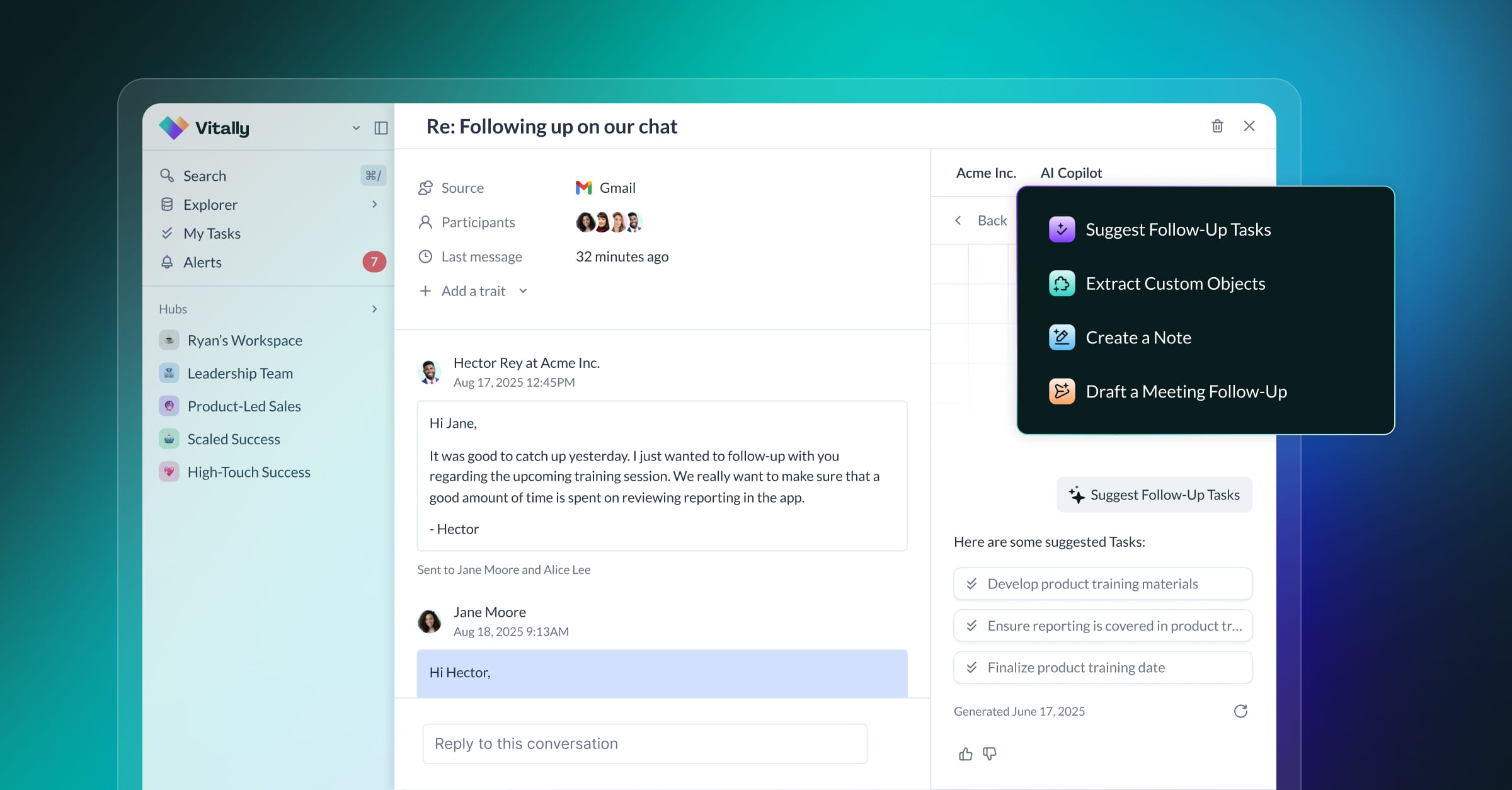
Here’s what one customer has to say about Vitally’s AI capabilities:
“In just one year, Vitally has fundamentally transformed our Partner Success organization… it has truly become the central nervous system for all our customer-facing activities. The new AI-powered features are phenomenal. The Meeting Recorder automatically joins, transcribes, and summarizes our Zoom calls, and the AI Copilot helps us instantly uncover risks and key insights from across the entire customer account. The AI meeting summaries alone have been a massive time-saver and have significantly improved our post-meeting follow-up.”
Download the AI Prompt Book for CSMs
Churn is often the problem that gets the C-Suite’s attention and can be a major source of stress for busy CS teams.
With the right blend of AI in human-driven workflows, CS teams can spot churn risks faster and prioritize work more effectively, mitigating churn before it becomes a problem.
But AI can be used for so much more than predicting and preventing churn. We compiled a list of our favorite prompts to automate your CS workflows, from spotting churn risks to meeting follow-up. Save your favorite prompts, create a custom GPT, and see how much time you can save across all of your accounts.
Get your free copy.
Table of Contents
Request a Demo

Request a Demo
Request a Demo