Use AI more. But don’t make it obvious. And don’t forget to be human.
They sound like competing demands, don’t they? Today’s CSMs are asked to do more than ever before, while juggling the fear of sounding too robotic and turning customers off.
You can’t deliver a stellar customer experience at scale without a little help from automation. Not while keeping your sanity anyway. That’s where empowering the human connection while scaling with AI is so critical. And we were grateful to have Linnea Olson and Nina Wilkinson from ScaleUp CS join us for a recent webinar on this very topic.
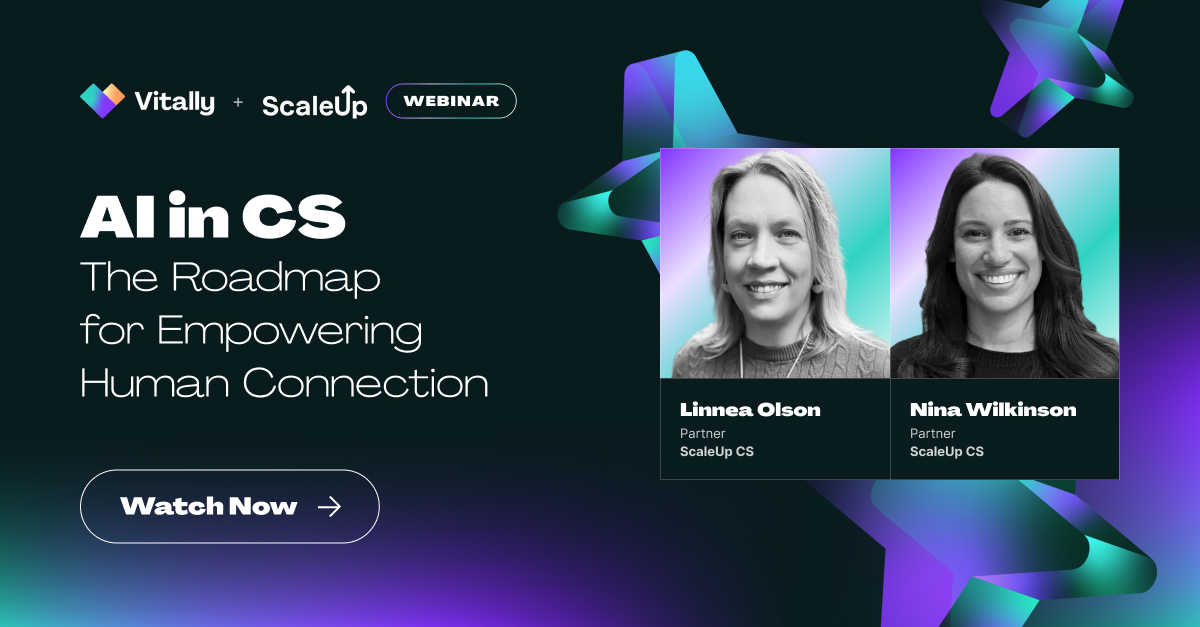
In this guide, we’re distilling what Linnea and Nina shared to explain how to stay human with your customers while automating as much as possible with AI.
Why Use AI? Simple: AI Saves You Time
Your most precious resource as a CSM is time.
More time means doing the things you love and excel at – like talking to customers and doing good work. Everyone agrees that AI can be a massive timesaver, but the problem is that when you let AI do too much of the talking for you, it removes the human touch you can provide.
Here’s a helpful distinction Nina shared: AI helps you with capacity, not with discipline.
If you’re a CS leader, you probably should review your team’s calls every week to learn your product’s limitations and see how CSMs are performing, how they handle objections, or where customer sentiment really sits. You have the discipline to do that, but it’s unlikely that you have the bandwidth to. At least not every week.
With a team of 10+ CSMs, most CS leaders are lucky to review 2-3 calls per week, usually at 2-3x speed, which strips tone and nuance from the recordings. AI doesn’t fix the discipline here, but it does help with capacity by allowing you to “listen” to every call and decide how to allocate your time.
AI can increase your capacity and augment the work that you do. We’ll dive deeper into specific examples next.
Send the Human in Earlier, But Better Prepared
Nina elaborated on the previous example in the webinar to share how she coaches CSMs by scoring their calls.
She now uses AI to automatically score every call and post a digest for her in Slack every Monday morning. This allows her to find out what’s worth celebrating and what’s worth coaching in under five minutes every week.
The real win is what she is freed up to do. By not guessing what call is worth listening to, she’s not rushing through and missing things. This allows her to drill into specific calls and provide actionable feedback. In other words, AI frees Nina up to do the work that actually needs a human.
On a similar note, Linnea mentioned building an AI-powered flow to catch signals buried in SDR calls. Linnea noticed a pattern of risk signals that surfaced early in the sales process, so rather than manually digging through recordings, she built a system to automatically pull quotes and enable CSMs to respond directly before accounts churn.
Rather than being caught flat-footed, her CSMs showed up prepared and could reorient the call back to a valuable conversation. Time savings coupled with better preparation can lead to much better outcomes for your CS team.
Larry Hogan, Global VP of CS at Triptease, is a great example of this in action. When Larry joined Triptease, the CS team juggled priorities across several tools and spent more time tracking down data than helping customers succeed. After implementing Vitally and leveraging its AI Copilot, his team reclaimed 30% of their time each week, allowing for more strategic work to drive performance. Read the full story here to see how the Triptease team did it.
There’s a pattern here: automating the mechanics so the human can show up sharper. It’s not about replacing people as much as it’s about giving you better data and insights so you can be better at what you do.
An Example of AI in Action: Customer Handoffs
Data analysis and call prep are one thing, but sales-to-CS handoffs are another great example of how AI can improve your processes.
We’ve all started off a kickoff call with something like, "So, tell me a little bit about your business and what you're hoping to accomplish."
That customer just spent two hours explaining themselves to your AE, explaining exactly why they bought your product, and now your CSM is asking them to rehash the whole story. That’s a pain for the customer, and it kills your ramp time. Userpilot conducted a 2024 study that found 74% of customers churn due to a poor onboarding experience, so there is a greater risk here than simply getting off to a slow start.
Why not use AI? Nina shared how she used AI to automate the brief: When a deal closes, the system reads the sales call and the CRM data and drafts a handoff doc that includes the customer’s core problems, how the product solves them, the roadblocks, onboarding challenges, and timelines. The AE reviews it in under five minutes to correct any errors and sends it to the CSM to catch up on their newest account.
This turns the “Tell me about your business” question into a specific and actionable conversation starter like, "I talked with Susie on sales, I know you had X, Y, and Z problems, you've got a deadline coming up, and you're mid-transition on your tech stack – let's talk about how all of that affects your onboarding."
A lack of context makes the customer repeat themselves and misses details they gave three calls ago. Going in with the full context allows you to hit the ground running.
This still requires some effort on your part to set things up with AI — if you use an AI-powered Customer Success Platform like Vitally, which brings all of your customer and sales data together in one platform, you can do this in seconds with AI-generated summaries from call transcripts.
Know the Limits of AI, and Where You Can Excel
AI is great for pulling insights together, generating summaries, and reviewing large datasets. But it’s important to use AI responsibly and for the right tasks
Nina and Linnea agree: AI doesn't replace the human in the call. CSMs aren't going anywhere. People are what matters.
But when you’re managing 100+ accounts, there is no way you can spot churn risks, manage renewals, help your customers be successful on the product, and have a life unless you get a little help. Today’s CS leadership needs CSMs who have their best shot at working with customers and doing it well. That means walking into every call informed, building the right decks, and using their people skills where people skills count.
For CSMs, this should be great news. It means less time drowning in grunt work that doesn’t require a human.
If you want to start somewhere this week, start small: pick one call from last week, write your team's rubric down in markdown, and wire up a webhook in your CSP to act on it. That's it. Let the system handle the mechanics and save your people for the people.
Automate The Busywork While Providing Human Value With These Claude Skills
As you’ve seen, AI has the potential to arm your CSMs and CS leadership with better insights, customer trends, and warning signals before they turn into churn risks.
You can’t just open up Claude and expect gold, though. You need to tell Claude how to think, what to look for, and how to respond. The best way to do that is with Claude Skills, which are Markdown files that instruct Claude to act the way you want it to.
If you’re unsure of where to start, don’t worry – we’ve got you covered.
Click the button below to access our Claude Skills library, where you can browse available markdown files written specifically for different CS tasks. Automate QBR prep, call follow-up, churn management, and much more.
Table of Contents
Request a Demo

Request a Demo
Request a Demo