
Your product analytics show a customer's login frequency. Your CRM tracks contract value. But neither tells you whether your champion is frustrated or if a renewal is actually at risk.
For that, you need qualitative data from surveys.
You could sign up for a dedicated survey tool like SurveyMonkey or even a free option like Google Forms, but is that the best way to collect customer responses and integrate them into your CS process? In this article, we’ll round up the best survey tools for Customer Success teams with an emphasis on tools that allow you to easily create surveys and analyze responses at scale.
The Types of Surveys You’ll Need to Run
Before reviewing our top software options, let’s level-set on the types of surveys you will need to run. The standard survey types are:
- NPS (Net Promoter Score): A classic. NPS surveys ask customers how likely they are to recommend your product. These can typically be sent out quarterly or biannually to track overall satisfaction.
- CSAT (Customer Satisfaction): Another CS mainstay. CSAT tracks customer satisfaction, usually around interactions with support or after major milestones
- Churn/cancellation surveys: Churn is an opportunity to capture data, too! When customers downgrade or leave, ask them why. Your product team will love you for this.
But you can (and should) break the mold and create custom surveys to capture qualitative feedback from customers. Check out our guide to creating customer surveys for a deeper dive, with examples to follow.
Then comes the fun part: put the data you collect to work in your CS org. You’ll need to track NPS and CSAT across segments in shareable reports, and feed responses into your custom health scores to give you a bird’s-eye view of every customer.
Without a system for surveying customers, you’re flying blind when it comes to knowing how they feel about your product. So read on for the best survey tools to pick from.
The Top Survey Software Platforms for Customer Success Teams
We chose the following six software platforms based on their features, user reviews, functionality, and G2 ratings. The best survey software platforms we found are:
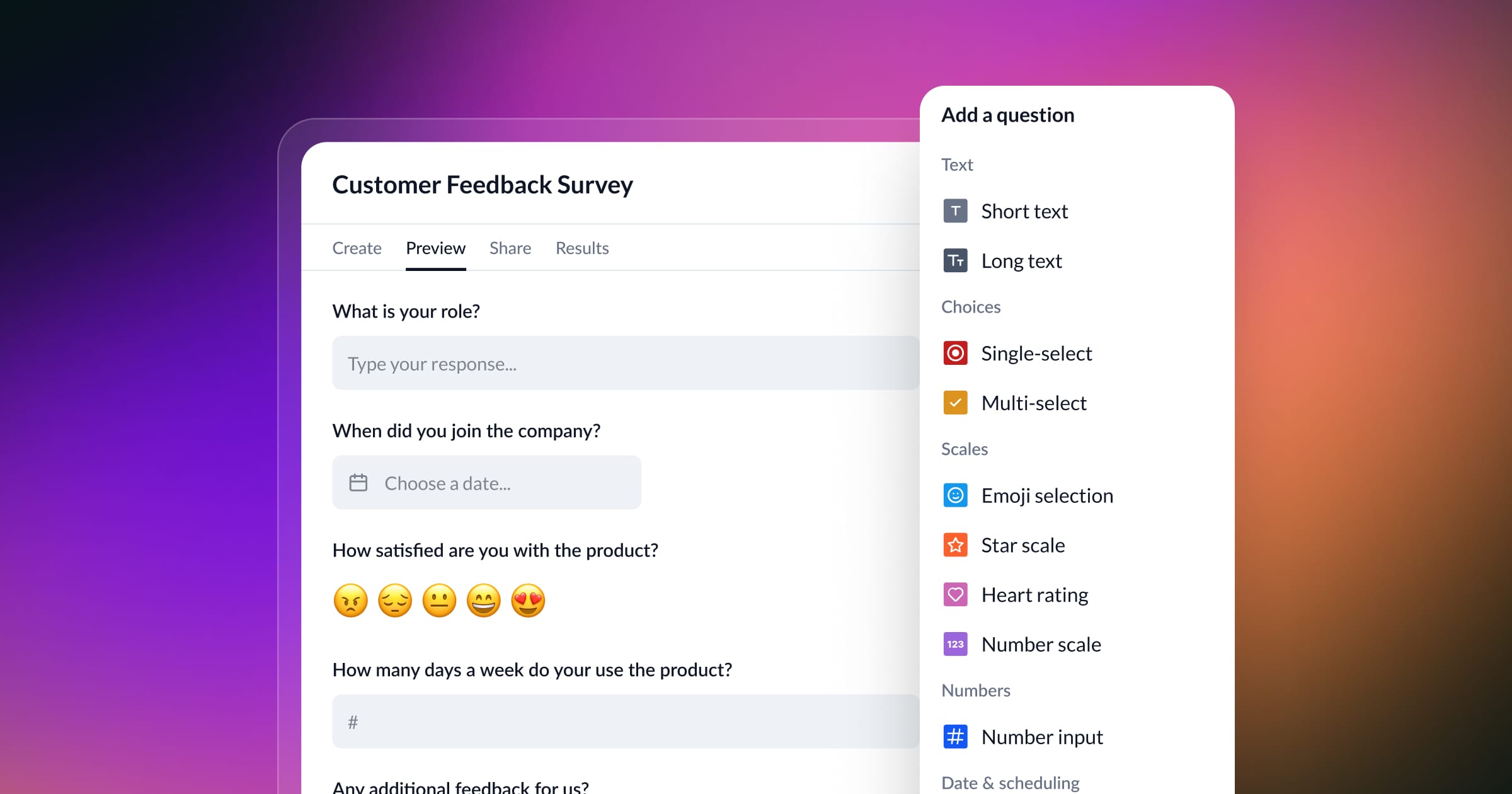
Vitally is a leading Customer Success Platform (CSP) and one of the most complete solutions on this list for CS teams.
Vitally’s survey capabilities are top-notch. You get access to built-in NPS and CSAT surveys to gather customer feedback at scale, and the ability to create custom surveys to collect feedback from the right customers at the right time, fueling your processes. If you want to know how customers feel about your product, how happy they are with the level of service you provide, or pretty much anything else, you can find it out with Vitally’s survey tools.
You’ll get control over when and how surveys are sent, too; you can send surveys via email or trigger surveys based on customer actions, giving you all the flexibility you’ll need to collect the data you want. You can also report on and share survey insights instantly across your team. Here’s what one happy customer has to say on G2:
"I find Vitally to be the perfect level of detail for our needs. It allows us to easily survey our customers at any time, so that we can always understand where to prioritize our efforts…One of Vitally's strengths is how customizable it is. You can set your own indicators, create playbooks, and configure views to fit your needs. I think it's the perfect tool for an early/growth stage team working to build out its customer success function. Especially when you don't have numerous CSMs, Vitally definitely allows each and every team member to be more productive."
As a CSP, Vitally also offers dashboard and reporting tools, sophisticated automations, churn management features, AI capabilities, and much more:
When you think about “survey software,” it’s hard not to think about SurveyMonkey.
SurveyMonkey is one of the top survey platforms on the web and a solid option for Customer Success teams. SurveyMonkey offers a ton of powerful features, including advanced question types, branching logic, branded surveys, and plenty of pre-built templates you can follow.
SurveyMonkey also supports common “close-the-loop” workflows via integrations (e.g., pushing survey responses into systems like HubSpot or Salesforce, enabling CS to segment accounts and follow up based on feedback). If you’re looking for one of the best survey solutions on the web, SurveyMonkey is a good choice.
Survicate is less of a survey tool and more of a dedicated feedback platform, making it a great option for CS, Product, and Marketing teams alike.
Survicate supports standard CS metrics like NPS/CSAT/CES and can collect feedback across channels from your product and website to email. Where Survicate excels is in feeding this data into your CRM, so you can automate follow-ups and activities based on customer responses.
Like the others on this list, Survicate includes plenty of features for creating, distributing, and analyzing surveys, making it a solid choice.
Looking for a super simple way to collect customer feedback? Simplesat might be a good fit.
As the name suggests, Simplesat is simple. It offers support for “one-click” feedback that can be embedded in your emails and within your existing marketing tech stack. CS teams can use Simplesat for CSAT, CES, and NPS feedback, and use helpdesk triggers and automations to run post-survey actions.
Of the tools on this list, Simplesat is definitely the simplest option to start with and may not work well for the more sophisticated needs of larger CS orgs.
Looking for another CSP to choose from? ChurnZero is a solid choice, with several features that empower your CSMs to get more done and automate tasks.
Like Vitally, ChurnZero offers tools for NPS, CSAT, and CES surveys with the ability to create custom surveys to gather specific feedback.
As an established player in the space, ChurnZero may be harder to configure than some of the simpler survey tools on this list. For example, the following G2 review cites the rigidity that can come with ChurnZero:
"If you're looking for a fully customizable option, this isn't for you. While it is an off-the-shelf software, it does offer some customization, although not 100%. For instance, we calculate survey results differently than ChurnZero does, and there isn't a way for us to manually create a formula in the dashboards to calculate it our way. Therefore, I have to export survey results and calculate them in Excel or Google Sheets."
In contrast, a platform like Vitally was built to give CS teams that same power with more flexibility: sophisticated automations and custom dashboards that calculate metrics your way, without needing workarounds.
If you’re looking for another simple customer survey tool that can support a broad set of use cases, then Qualaroo is a good option.
Qualaroo is a bit different from the other survey tools on this list in that it can help you collect contextual feedback from users as they use the product or visit key pages. Qualaroo is built around on-site/in-app “nudges,” with targeting rules that let you ask the right question based on where someone is in the journey and who they are (useful for adoption friction, feature feedback, onboarding drop-off, and pre-renewal risk signals).
This makes Qualaroo more of a feedback tool than a survey platform, but it’s still worth mentioning as it may be a valuable addition to your tech stack.
A Side-by-Side Look at These Customer Success Survey Tools
We’ve covered a lot of ground so far. To help you make a decision, here’s a quick side-by-side of the survey tools above:
What to Look For in Customer Success Survey Software
There’s a range in the tools we listed above. Some are fully-featured Customer Success Platforms (Vitally and ChurnZero) while others, like Survey Monkey, are dedicated survey tools.
Which should you choose for your tech stack?
Ultimately, it depends on your goals: Are you running surveys to collect feedback at a small scale, or to feed data into your CS org to guide initiatives?
If it’s the latter, then we’d recommend considering the following factors:
- Choose a tool that slots into your tech stack
- Choose a tool that enriches your data and guides decisions
- Choose a tool with top-tier AI capabilities
Choose a Tool That Slots Into Your Tech Stack
Survey tools are essential, but don’t forget that the point of running surveys is to collect valuable data from your customers and integrate it into your existing workflow.
Tools that exist in isolation provide far less value than those that can easily mesh with your existing tools. This starts by assessing your tech stack for Customer Success. Are you using a CRM to manage customer, sales, and marketing data all in one platform? You’ll need to select a tool that integrates with your CRM without muddying data for other teams.
If you’re using a fully-featured CSP, like Vitally, then you get a native survey tool built into your workflows.
Choose a Tool That Enriches Your Data and Guides Decisions
Remember, the point of surveys isn’t just to say that you send them. It’s to collect data that's easy to analyze and use to guide major decisions for your team.
That means you should prioritize tools that make it easy to report on data, drill down into responses, and feed that data into health scores and other automated systems to guide customer management.
For example, Vitally’s reporting tools are hard to top because they let you bring customer, product, and survey data under one roof into powerful (yet easy-to-use) dashboard reports. In seconds, you can spot trends, review segments, and even forecast renewals or predict churn.
If you’re looking for a survey tool period, there are plenty out there to choose from. If you’re looking for a survey tool that can integrate with your existing data to shape CS decisions around churn, renewals, or processes, then a CSP like Vitally is the clear winner.
Choose a Tool With Top-Tier AI Capabilities
Most survey tools use AI to draft questions. Vitally uses it to analyze thousands of responses, flag at-risk accounts, and automatically suggest follow-up actions.
Sure, generating a survey is a timesaver. But content generation is the “entry-level” use case for AI. What’s more interesting is how CS teams can use AI for more advanced tasks, such as analyzing customer data, spotting trends, synthesizing feedback, or even acting as a co-pilot to automate workflows.
These aren’t just marketing concepts; Triptease shared in a recent case study that they reclaimed 2+ hours each week and up to 30% of CSM time, all thanks to Vitally AI. With Vitally’s AI features, Triptease captured customer call summaries, ran automated pulse checks, synthesized product feedback, and generated follow-ups with minimal oversight.
Here’s what Larry Hogan (Global VP of CS) had to say:
“The concept of being a truly strategic CSM was impossible before. With the AI features in Vitally, now they actually have the time and visibility to do the work they were hired to do…. Before Vitally, there was no easy way for a CSM to see, ‘Here’s the revenue at risk this quarter.’ Now it’s right in front of them.”
Many survey tools may excel at leveraging AI in-app to create surveys, but only a CSP like Vitally integrates AI throughout the platform, empowering you to work smarter, not harder.
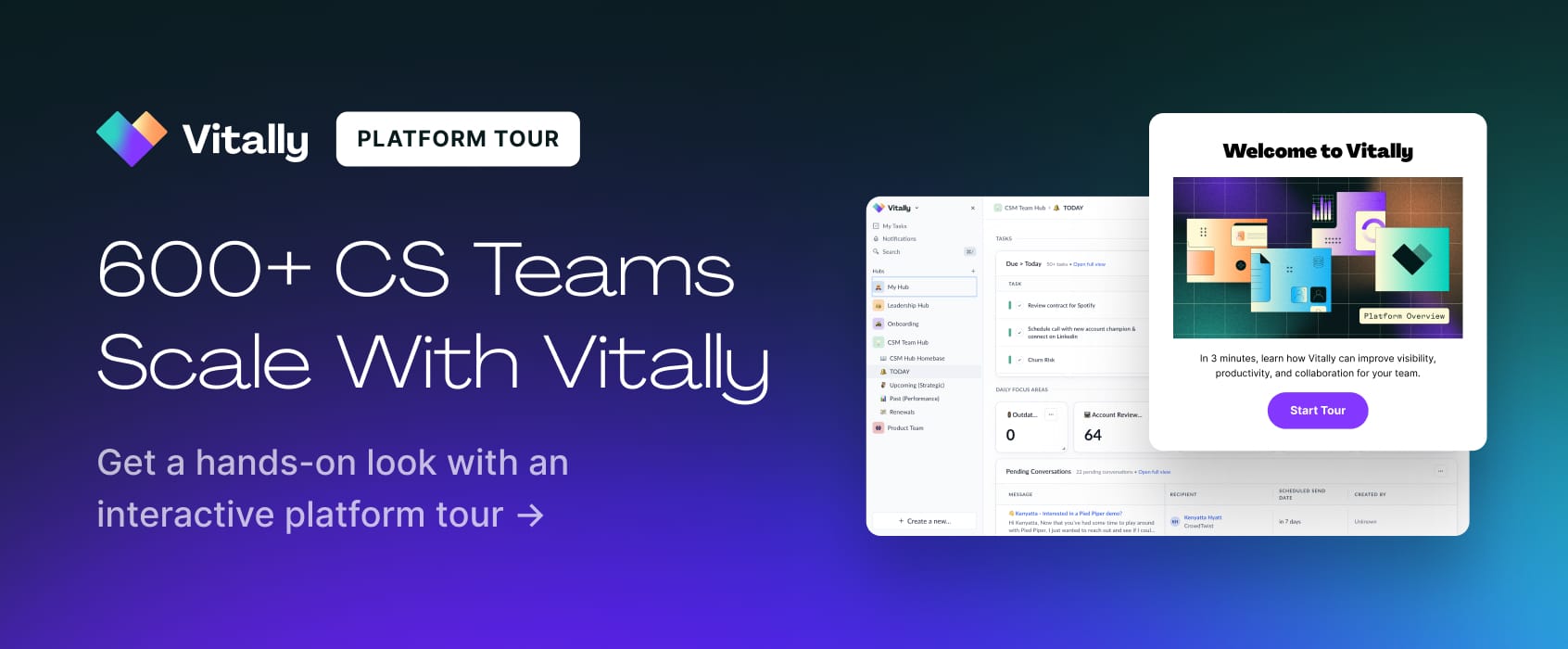
See Why 600+ CS Teams Trust Vitally: Take a Platform Tour
If you’re going to pick one tool from this list to collect and analyze customer feedback at scale, we’d recommend a CSP like Vitally, purpose-built for CSMs' needs.
While many CSPs offer the same suite of features for logging customer data and generating reports, Vitally stands out for its integration capabilities, flexibility, and speedy implementation timeline.
You don’t have to take our word for it – and you don’t even need to schedule a demo (though you can here, if you’d like). Click the button below to take a Vitally product tour. You’ll see the best that Vitally has to offer, and how your CS team can serve customers at scale.
Table of Contents
Request a Demo

Request a Demo
Request a Demo